
New
Net Zero Carbon Heating
New Heating 2025
Our new electric heating system was
made possible by a large grant from the
Church of England’s Net Zero Carbon Programme’s
Boiler Replacement Hardship Grant Fund
and grants from the
Benefact Trust
and the
Listed Places of Worship Grant Scheme
We are also exceedingly grateful for the very generous donations from our
local community
and for a fundraising concert given by the
Kenelm Singers
In 2025 the heating system in our church was converted from oil to one based solely on electricity. This conversion was rendered necessary by a damaged oil storage tank and an aging oil boiler. It was an opportunity to convert to a net zero carbon system using green energy, and the work fell within the scope of the Church of England's Net Zero Carbon 2030 project.
The system installed was recommended by the Diocesan advisor, Matt Fulford. The old system components were removed and infrared panel heaters provided instead of the old water-based radiators. Heaters were also installed under all pews; 121 under-pew heaters were installed in all.
We can now offer a heated seat on every pew in the church, but we are still trying various configurations of the new system in order to create a warm environment for the congregation to enter and sit in.
A new electricity supply had to be fitted by National Grid Electricity Distribution to meet the increased demand. This was a three-phase supply and required trench excavations across the churchyard and a neighbouring third-party field. Excavations on church property had to be monitored by an archaeologist both inside and outside the church, but nothing significant was unearthed.
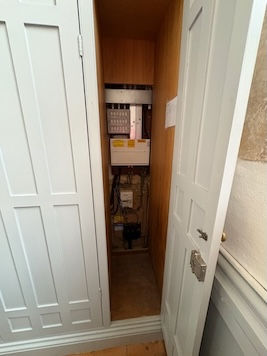
A new wiring infrastructure had to be provided inside the church including a new fuse board. Most wiring could be hidden behind cupboards, wooden side panels, under wooden floors and in some instances under stone floors.
The project was under the control of James Rees of Falconer and Gilbert Scott Architects. The main contractor was Turnkey Construction Ltd, who sub-contracted the electrical work to MD Electrical Contracting Ltd. The archaeologist was Richard Cherrington of Benchmark Archaeology.
Originally, it was thought that the work might have to take place in three stages. In fact, enough funds were raised to enable all the work to be accomplished in one stage. A loan was obtained from Gloucester Diocese to help with cash flow especially with respect to VAT payments.
Original net cost estimates were in excess of £70,000. In fact the latest assessment of the net cost is over £82,000. The contribution from church funds is likely to be less than £5,000.
Work started on the electric heating system on 21 July and most of the work had been completed by 3 October. A few snagging items had to be satisfied (most have) and a wooden fuse board cupboard still had to be fitted. This was fitted on 17 November. The architect signed a certificate of practical completion on 27 November, and the faculty completion certificate was submitted on 10 December.
A few additional items added to the initial cost estimates:
-
removal of the old heating system: oil boiler, oil tank and some pipework
-
a wooden cupboard to cover the new fuse board as this could not be accommodated in an existing cupboard as planned
-
reconstruction of the vestry cupboards as the three-phase power supply could not be accommodated in the existing space as planned
It is impossible to estimate the running costs for the new system accurately, but this will be monitored carefully. The electricity charge for heating and lighting a service in winter is costing up to £30.
Oil boiler removed


Three-phase supply provided


Floors lifted and replaced


Heaters installed


